There are dozen and dozen of little interesting twist in Wano and a few very large and amazing one and one narratively groundbreaking one. I'll take from the very beginning, meaning chapter 909 and not 910.
Loading...
Ok so the first twist is a small and interesting one : Zoro's seppuku, indicated directly in the title of 909. For this chapter, we are thrown into conflict and led to believe that Zoro is being forced to Seppuku himself. Here Oda plays with our knowledge of the old Japanese culture AND our knowledge of Zoro's character. We know Zoro is pridefull and very consistant when it comes to honor so this situation exposes us a a very weird feeling of "wtf is he about to do?" from the get go. I remember very well feeling unsettled by this page.
Especially when he seems to begin the ritual. (
and it's even worst when you watch the anime as Zoro will literally stop the blade 1 inch before his belly).
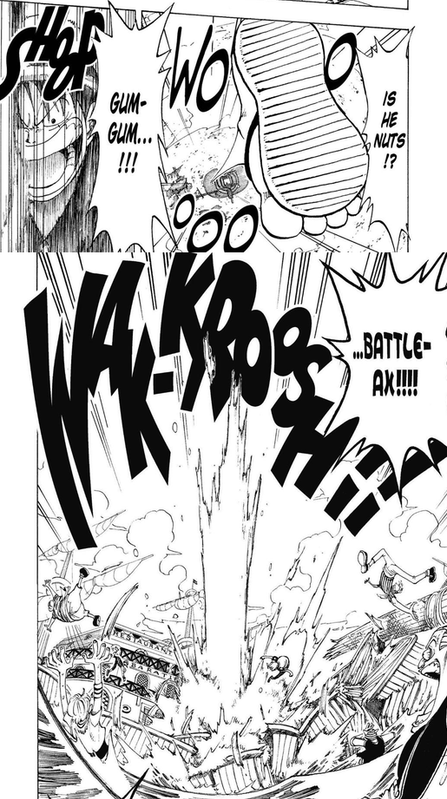
Gadly, this is but fake out and Oda is subverting our expection of the ritual, Zoro is actually using this ritual to confirm a suspicion and slash the culprit and executionner, creating this iconic panel and demonstrating Zoro's strenght at the same time:
This is a twist, a little one, created from a very short but intense window of expectation (two pages). But very important thematically because it announces a thematic:
The old will overlay the new and in Wano, warriors do not sacrifice themselves for nothing.
Oda is not just presenting Zoro punishing a bad man here, he is using a suppuku scene, a process that is highly charged and sacred in japan, to create a subvertion. In any other japanese medium, refusing to suppuku while performing the ritual would be seen as anything but honorable, especially with a character like Zoro representing the idea we make of an honorable Samourai. But zoro is not just a samourai, he is a Ronin without master, on top of that he is a pirate pushed by ethical and personnal necessities. So it make sense for Zoro to refuse the ritual and slash the executionner but on the page, it sends a message :
"Fuck Suppuku".
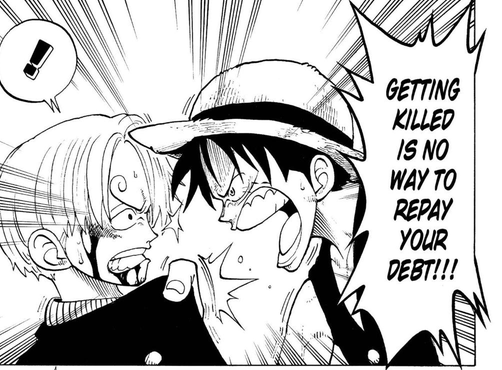
And this idea of refusing a worthless sacrifice is very prevelant in the work of Oda, you can see that all the way back to the Baratie Arc where Luffy specifically get angry at Sanji for trying to sacrifice himself for the wrong reason. This is why he does this to wake him up.
Through this 4 pages. Oda makes a point about meaningless sacrifice, especially regarding what we can see as the warriors of Wano.
At the same time, he is also making a point about his vision of japanese culture but also his own world :
In his world, in wano, the youth won't perpetuate the ideas of the old. The old will be replaced by the new BUT traditions and beliefs will be questionned and challenged.
This principle uncompasses the entire premisse of Wano
: The attempt to create a new country and open it up. The entire arc will be constructed on this premisses. For the entire duration, we will be led to believe that Oda is trying to "open up" Wano and japan by extention. For that, he is helped by the current knowledge of the world and japanese on japanese culture and geopolitic and the understanding that in a global and progressive world, a country must indeed be opened to avoid sinking back in otarcy. So we are led to believe in this premisse based on moral necessities.
This is precisely why Momonosuke refusing to open the country is a massive twist. At this moment, he understands that such dream can only be created through good material needs and conditions. This preparation was created to allows Momo's growth and fool us on One Piece's worldbuilding in the process.
As for the refusal to perpetuate the errors of the old (
meaningless sacrifice here), this will be the preparation for Oden's story. And this is something most people didn't catch :
Oden made two massive error. (
I'll come back to that)
Oden is presented like a ancient demi-god, much like heracles (
Oda reproduced the godly challenge at the beginning of his story). He is presented as THE ALPHA MAN. The man that we should all look for, man that will be rendered charismatic almost by destiny itself. And in many aspect, Oden is presented to ressemble Luffy in every point, but again, it is just an illusion created by Oda:
In reality, Oden is the philosophical opposite of Luffy as
Oden escaped his responsibility and fought alone.
The entire story of Oden is a development of a man who, wounded by the realization that his desire to escape impacted his kingdom, decided to fight back alone to correct his mistake and thus, was fooled and defeated in the process.
It's so prevalent that Oden is presented through an allegoric representation of a japanese cultural legend and Atlas, the man who carries the world and thus the pain and suffering on his shoulder, alone:
It is the representation of self sacrifice, in this case, a meaningfull YET avoidable sacrifice.
Oden could have fought Kaido from the start and created a rebellion, but instead, he escaped his responsibility and decided to face the threat alone, fooling himself in the process:
Oden was not a fool lord or a deity, he was not a gardian angel, he was a flawed man with a lot of ego and this ego lead him to boil.
This types of errors are something that Luffy, at least until now, is physically incapable of doing. Oden while being presented like a second Luffy, was more deeply constructed as the philosophical antithesis of who Luffy is. Or rather, Luffy is presented as the antithetic solution of the liberation of Wano.
When Oden is presented like a meaningless sacrifice that is being fooled and forced to attack unprepared to be later defeated. Luffy is presented as the consequential leader of an alliance of people fighting TOGETHER and relying on EACH OTHERS to proceed and accomplish the liberation of Wano.
This is why Wano is all about the overtaking of the new generation over the old and this is propably why Oda decided to make Kid and Law fight Kaido and Big Mom along side Luffy.
If you followed my analysis, you should know that I repeated lsomething very specific about the Yonko Saga over the years: The Yonko Saga is not just about pirates fighting emperors,
it's a reflexion about parenting and the relationship between children and parents. Or more exactly: about
kids fighting and standing up to oppressive parents while recreating meaningfull bonds through found families.
Perhaps you think that I'm just throwing that in the wind because there is a character named Big Mom and another named Kid. But you have to see the the GLOBAL Saga as a philosophical thesis and not just simply as a sets of arcs coming up one after another.
Most of the characters if not all and their actions within this saga are ALL representing an argument on the philosphical reflexion about parenting, the relationship between children and good or bad parents, the way they are abusive or not and how children will react to that or line up. And that, in a more prevalence way than in the rest of the story.
I won't give you all the analysis here, it would take too much time, on the fly, you can think about the story of Yamato parralleling the story of Katakuri, the way different form of parenting are presented (Capone, Big Mom, Judge, Zeff, Oden, Kaido, Toki, Yasue, ) and how the children will be impacted and react to these character (especially Momo, Sanji, Yamato, Pudding, Katakuri, Hiyori, the scabbard which are treated as ignored yet loving kids etc.)
Overall, the yonko uncompass a reflexion on the relationship of the new generation with the old and the way it will act upon it. When Whole cake will be all about the perpetuation of the amazing values of Zeff, creating a situation of danger for Sanji, Wano will be the opposite and will rather be a depiction of a situation where the new generation, while respecting the old, will avoid repeating its errors and wishes to find their own way.
Kaido and Big Mom represent the two occurence of oppressive parents, the dad side, with physical abuse, linked to a sur-representation of strenght. Represented like an Oni commanding beast, a largely used representation for oppressive dads... and Big Mom representing the toxic mother, abused and ignored and perpetuating a cycle of abuse through a violence against her "loving children" either physically (Moscato) or psychologically (pudding), pushing the weakest to fly away (Chiffon) and strongest to protect those who are in danger of abuse (Katakuri)(Brulee) > Which is why Katakuri allowed Luffy to go, as he liberated partially him from his fears:
As such, the fight of Luffy, Momo, the scabbards, but also the character arc of Yamato is fundamental ( as I tried to explain many time before...). They are the representation of the new generation that, standing on the sacrifice and errors of the old, to find their "own ways" to fight.
I already explained why Momo acted the way he did and why it was depicted as a negation of the wish of his father (while keeping a respect of his promis) and for Luffy, well it's Luffy, he is represented as the kid that you can't lock away, the kid that will be free no matter the circomstance, he represent and idealistic version of the liberation from childhood that comes from the reliance on others... The guy can't fight alone and as such, his best strenght is to fight aloneside others. Which is presented as the reason for the victory in Wano.
As for Yamato, he took ALL bigger than life characterizations of Oden to push himself to become a man and survive the grip of child abuse. This is why Yamato can say "I'm Oden" so confidently, because for him, Oden made no mistake as Oden is the personnification of who he wanted to become YET.... he chose to fight his own way and chose to create his own path by not sailing out at sea like Oden but rather by staying behind to keep Wano safe and therefore uphold a form of responsibility, which Oden didn't.
This is why starting Wano with a Suppuku and a twist about the ritual was so important. It sends an important thematic message that is now regarded as the setup of an amazing arc.
I think I'll stop here. One twist is already too much and I'm not planning in writing a book. But the important thing to understand is that such analysis is directly linked to the critical analysis of the writing of Wano, I'm not just rambling random stuff here.
In fact Ode probably integrated things that I'm not even aware of yet.




 cute
cute
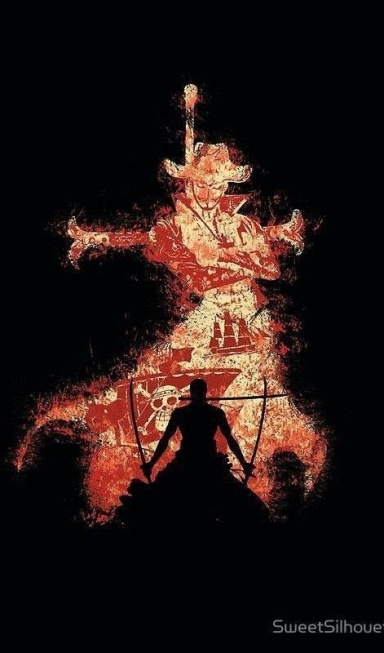

 I think it's still on the books. We the reader will know that zoro is the wss when he defeats mihawk. Unless the fight is broadcast to the world then imo zoro still needs a feat afterwards... Ik it's a novel but the zoro novel had marines talking about what makes the wss and to them it's by feats done by the swordsman. Since people say in a 1v1 bet on kaido, and they also say he is u killable there isn't really a better feat to the op world than seeing kaido slain by zoro. At that point the world acknowledges zoro as the wss.