IMPORTANT: THIS TIME THERE WILL BE NO FIGHTS. YOU WILL SIMPLY VOTE FOR YOUR TOP 6 CHOICES HERE. PLEASE TRY TO USE UP ALL 6 VOTES. THANKS.
THE BRACKET
Buddha - Record of Ragnarok
VS
Aki Hayakawa - Chainsaw Man
VS
Kamina - Gurren Lagann
VS
Mugen - Samurai Champloo
VS
Light Yagami - Death Note
VS
Nona Ewin - Witchriv
VS
Aomine Daiki - Kuroko no Basuke
VS
Lavi - D.Gray-Man
VS
Zeno Zoldyck - Hunter x Hunter
VS
Sinbad - Magi: The Labyrinth of Magic
VS
Eren Yeager - Attack on Titan
VS
Escanor - The Seven Deadly Sins
THE BRACKET
Buddha - Record of Ragnarok
Buddha is introduced as one of the gods expected to fight against humanity, but his decision to side with the humans immediately establishes him as an independent figure. His attitude is relaxed, irreverent, and openly dismissive of divine authority. He does not seem particularly concerned with the expectations placed on him by the other gods, and his willingness to follow his own principles makes him one of the most distinctive personalities in the tournament. His past and his relationship with the idea of enlightenment give his defiance a philosophical foundation.
Buddha's worldview revolves around personal freedom and the refusal to let others dictate how a person should live. He is not interested in obedience for its own sake, whether that obedience is demanded by gods, institutions, or tradition. His combat ability reflects this individuality: he adapts, reads his opponent, and uses his understanding of emotions and intentions as part of his fighting style. His relationship with Zerofuku is especially important because it forces him to confront the difference between helping someone and allowing them to define their own happiness.
Buddha's appeal is his charisma and independence. He has the confidence of someone who has already rejected the authority of the world around him, and his relaxed manner makes his defiance entertaining rather than preachy. He is not simply a cool fighter; his character gives the series a clear thematic argument about self-determination. His presence is memorable because he seems entirely comfortable being himself, even when that means standing against the entire divine order.
VS
Aki Hayakawa - Chainsaw Man
Aki is a Public Safety Devil Hunter whose family was killed by the Gun Devil. He initially approaches his work with a seriousness and discipline that contrasts sharply with Denji's impulsiveness. His motivation is revenge, and he is willing to accept dangerous contracts in pursuit of the devil responsible for destroying his life. When Denji and Power become his housemates, however, his role begins to change. He gradually becomes a caretaker to two people who are difficult, reckless, and emotionally demanding, even though he initially regards them as burdens.
Aki's development is one of the most affecting parts of *Chainsaw Man* because it grows out of ordinary domestic interactions. His life begins to revolve around people rather than revenge, and he develops a genuine attachment to Denji and Power. This does not erase his past or his original motivation; it makes the eventual conflict between his personal desires and his obligations more painful. His contracts with devils also carry real costs, reminding the reader that his professional life is built around sacrificing parts of himself.
Aki is compelling because he is neither an extravagant personality nor a grand ideological figure. He is a serious young man who has lost almost everything and slowly discovers that he can still build a family. His emotional restraint makes the moments when he shows affection especially effective. His story captures one of the series' central ideas: people can become attached to one another even in a world that treats human life as disposable. His tragedy works because the reader has seen the ordinary happiness he has begun to value.
VS
Kamina - Gurren Lagann
Kamina is one of the central figures in the early part of *Gurren Lagann*. He lives in an underground village but dreams of reaching the surface, refusing to accept the limits imposed by the world around him. His confidence, bravado, and enormous personality make him a natural leader, even when his actual abilities do not always match the image he projects. His relationship with Simon is central to the story because Kamina becomes the person who encourages Simon to believe in himself and imagine a life beyond the village.
Kamina's character is built around the power of belief. He often acts as though he has no doubts, but his confidence is partly a performance designed to give others courage. He recognises Simon's potential before Simon can recognise it himself, and he pushes him to act rather than remain trapped by fear. His attitude can be reckless and overly theatrical, but it has a real emotional function: he gives people permission to dream bigger than their circumstances. His relationship with Yoko also reveals a more vulnerable side beneath the bravado.
Kamina is memorable because his influence extends beyond his own time in the story. He represents the moment when a person discovers that the world may be larger than the one they have been taught to accept. His personality is loud, ridiculous, and intensely charismatic, but the emotional foundation is sincere. He is a character whose importance is measured not only by what he accomplishes himself but by the people he inspires to continue after him.
VS
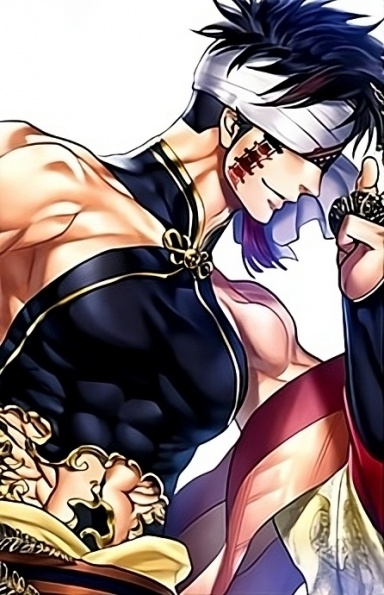
Mugen - Samurai Champloo
Mugen is a wandering swordsman whose fighting style is as unconventional as his personality. He grew up in a harsh environment and developed a chaotic, improvisational approach to combat that combines swordsmanship with movements resembling breakdancing. His encounter with Fuu and Jin leads him into a journey that initially seems to be about finding a mysterious samurai who smells of sunflowers. Along the way, Mugen's past, temperament, and relationship with other people become increasingly important.
Mugen is defined by his independence and resistance to authority. He is rude, impulsive, aggressive, and often motivated by immediate gratification. His relationship with Jin is built around constant friction because the two approach swordsmanship and life from opposite directions. Yet their rivalry also creates a kind of mutual respect. Mugen's past reveals that his apparent freedom has been shaped by violence and exclusion, and his journey gradually gives him opportunities to form connections that are not based on survival or conflict.
Mugen's appeal is overwhelmingly tied to personality and style, but those qualities are supported by a coherent character. He is not a conventional hero who gradually becomes respectable. He remains rough around the edges, and the series does not attempt to erase his individuality. His fighting style, humour, rebellious attitude, and refusal to conform make him instantly recognisable. He is one of those characters whose presence makes the entire work feel more alive.
VS
Light Yagami - Death Note
Light begins as an exceptionally intelligent student who is dissatisfied with the crime and corruption he sees in the world. When he discovers the Death Note, he gains the ability to kill anyone whose name and face he knows. He initially frames his actions as an attempt to create a better society, but his vision quickly becomes inseparable from his own authority. He decides that he should determine who deserves to live, and anyone who threatens his project becomes an enemy. The arrival of L transforms his private crusade into one of the most compelling intellectual contests in manga.
Light's characterisation is exceptional because the story explores the relationship between intelligence, ego, and moral corruption. His intelligence is not merely a collection of clever plans; it allows him to rationalise increasingly extreme actions while maintaining an image of himself as a just person. He is capable of affection, but his ambitions repeatedly take priority over the people around him. His relationship with L is especially effective because the two are intellectual equals in a contest where each understands that the other is dangerous. Their rivalry becomes a battle over identity, control, and the right to define justice.
Light's greatest strength is that his transformation does not require him to become a different person. The Death Note gives him the opportunity to act on impulses that were already present: his arrogance, his desire for recognition, his belief in his own superiority, and his intolerance of opposition. The story constantly places his self-image beside the reality of his actions, allowing the reader to see how far apart they become. He is a brilliant protagonist because his intelligence, ideology, flaws, and downfall are all connected. His character is not just about being clever; it is about what happens when someone brilliant becomes convinced that brilliance grants moral authority.
VS
Nona Ewin - Witchriv
Nona Ewin is a young girl born from the relationship between a human father and a mage mother in a society where magic is feared and its practitioners are persecuted. Her mother, Lancia, raises her with the knowledge that revealing her magical abilities could put her life in danger. Nona's childhood is therefore shaped by secrecy and the fear of being discovered. Her relationship with Lovi, a human friend who accepts her despite the danger, gives her a brief experience of belonging beyond the divisions imposed by society.
The tragedy of Nona's early story comes from the collision between her innocence and the cruelty of the world around her. When she uses her stitching magic, Altoare, to repair Lovi's broken glasses, her secret is exposed. Lovi and his family are executed, while Lancia sacrifices herself to protect Nona. The power of this story lies in how ordinary and compassionate Nona's action is: she does not reveal herself to gain power or prove anything. She simply wants to help someone she cares about. The response she receives exposes the brutality of the system around her.
Nona's defining quality is her gentleness in a world that gives her every reason to become bitter. Her stitching magic is especially fitting as a symbol: she possesses an ability associated with repairing and reconnecting things, while the society around her tears families and friendships apart. Her story is still developing, but the emotional foundation is strong. She represents the human cost of prejudice in a way that is intimate rather than abstract, and that makes her stand out.
VS
Aomine Daiki - Kuroko no Basuke
Aomine is one of the former members of the Generation of Miracles and a basketball player whose natural talent allows him to dominate almost any opponent. His relationship with Kuroko is particularly important because they once played together at Teiko Middle School, where their contrasting styles helped create an effective partnership. As Aomine became increasingly powerful, however, he grew bored with competition. He began to believe that nobody could keep up with him, and his love for basketball gradually deteriorated into a sense of superiority and isolation.
Aomine's character is built around the tragedy of talent without meaningful challenge. He does not stop loving basketball because he lacks ability; he loses his motivation because his ability becomes so overwhelming that the sport no longer provides the excitement it once did. His arrogance is therefore connected to a form of loneliness. He wants to play seriously, but he has convinced himself that nobody can force him to do so. His relationship with Kuroko is central to his eventual reconsideration of that belief, because Kuroko represents the kind of basketball that Aomine has forgotten how to value.
Aomine is compelling because his problem is unusual but recognisable: what happens when the thing you love becomes effortless? His confidence, improvisational style, and natural charisma make him an entertaining rival, but his character also explores the psychological consequences of being too far ahead of everyone else. His development is about rediscovering competition and learning that greatness is not simply the ability to dominate others. He is a strong sports manga character because his emotional conflict is directly connected to his relationship with the sport.
VS
Lavi - D.Gray-Man
Lavi is introduced as a cheerful Exorcist who accompanies Allen and the others, but his real role is tied to the Bookman clan. Bookmen record history while remaining detached from the events they observe. Lavi is expected to inherit that responsibility, which means that his friendships and emotional attachments conflict with the professional identity he is supposed to maintain. His apparent carefree attitude hides the burden of being trained to observe people without becoming personally involved.
His central conflict is between the person he is becoming and the role he has been assigned. Lavi genuinely cares about his companions, but he is also aware that attachment could compromise his ability to fulfil his duties. His multiple identities and the history of previous Bookmen suggest that the self he presents to others may be only one layer of a much longer pattern. The more he becomes involved in the war, the harder it becomes to maintain the distance expected of him. His relationship with Allen is particularly important because Allen's compassion challenges the detachment Lavi is meant to embody.
Lavi is compelling because his cheerful personality is not merely a mask for a secret identity; it is also something he genuinely values. His struggle is not simply to reveal his true self but to determine whether a person can remain an impartial observer while forming meaningful relationships. That conflict gives him a strong thematic role in a series concerned with memory, identity, and the cost of war. He is one of the more quietly interesting members of the cast.
VS
Zeno Zoldyck - Hunter x Hunter
Zeno is one of the most experienced members of the Zoldyck family and a highly respected assassin. He is Killua's grandfather and Silva's father, and his reputation is built on decades of professional work. Unlike Illumi, who often appears emotionally controlling, or Killua, who is still trying to escape the family's expectations, Zeno is comfortable with his identity as an assassin. He approaches his work with professionalism and generally avoids unnecessary complications.
Zeno's character is interesting because he combines an old-fashioned sense of discipline with a surprisingly pragmatic attitude. He understands the nature of the profession and does not romanticise it. His interactions with Chrollo during the Yorknew City arc are particularly revealing: despite being hired to kill him, Zeno can recognise his opponent's intelligence and discuss the situation with a degree of professional detachment. His relationship with Netero also reveals that he belongs to a generation of exceptional fighters whose understanding of strength has been shaped by experience rather than ego.
Zeno is not a character whose appeal comes from an elaborate emotional arc. His strength is his presence, experience, and understated confidence. He is dangerous without being theatrical and intelligent without constantly needing to demonstrate it. His ability to treat even an extraordinary opponent as a professional challenge gives him a distinctive dignity. He is a supporting character who makes the world feel older and more developed than the immediate story.
VS
Sinbad - Magi: The Labyrinth of Magic
Sinbad begins as an extraordinary adventurer whose achievements seem almost impossible for someone so young. His rise from difficult circumstances to the creation of Sindria establishes him as a figure of immense ambition, charisma, and capability. He is a Dungeon Capturer, a king, a diplomat, and a person whose influence extends far beyond his immediate surroundings. His reputation is not simply built on strength; it comes from his ability to attract people, inspire loyalty, and make others believe that a different future is possible.
What makes Sinbad interesting is that his charisma is not a superficial trait. It is one of his greatest instruments, but it also reflects something genuine about him. He can make people feel that they are part of something larger than themselves. At the same time, his ambition raises questions about the relationship between leadership and control. When someone becomes accustomed to shaping the world through sheer force of personality, it becomes difficult to distinguish between helping others and deciding what is best for them. That tension is central to what makes him worth examining.
Sinbad's appeal is his almost mythological presence. He feels larger than life without being reduced to a simple invincible hero. His accomplishments, confidence, and ability to command a room give him the aura of someone destined to become historically significant. There is also something compelling about the fact that his charm can make even questionable decisions seem reasonable at first glance. I am keeping this discussion within the point of the story you previously mentioned, rather than spoiling later developments.
VS
Eren Yeager - Attack on Titan
Eren begins as a boy who dreams of freedom beyond the walls and is traumatised by the destruction of his home and the death of his mother. His early hatred of Titans gives him a clear and emotionally immediate purpose: he wants to destroy the creatures that have taken everything from him. As the story expands, however, the meaning of freedom becomes increasingly complicated. Eren discovers that the world beyond the walls is not the empty promise he imagined, and his understanding of the conflict changes as he learns more about history, identity, and the forces shaping his life.
His character is built around the tension between freedom and determinism. Eren wants to make his own choices, yet his relationship with future memories and the inherited power of the Titans complicates the idea that he is acting independently. His anger, stubbornness, and inability to accept limitations remain consistent throughout the story, but their targets and implications change dramatically. The person who once fought to escape confinement eventually becomes someone whose pursuit of freedom imposes devastating consequences on others.
Eren is one of the most divisive and ambitious protagonists in modern manga because his development forces the reader to reconsider earlier interpretations of him. His motivations are not easily reduced to one explanation, and the story deliberately places his personal desires beside the immense suffering caused by his actions. Whether a reader finds every element of the ending successful or not, Eren's transformation is a major narrative undertaking. His character is memorable because the story turns his defining ideal—freedom—into the source of its deepest moral questions.
VS
Escanor - The Seven Deadly Sins
Escanor is the Lion's Sin of Pride and one of the most powerful members of the Seven Deadly Sins. His Sunshine ability causes his physical strength and confidence to fluctuate with the sun, leaving him timid and insecure at night while becoming overwhelmingly powerful during the day. This creates an unusual split in his personality: the same person can appear apologetic and frightened in one moment, then almost godlike in another. His relationship with Merlin and his comrades gives his story an emotional dimension beyond his extraordinary combat ability.
The contrast between his two states is central to his character. His daytime arrogance is not simply confidence; it is an overwhelming sense of superiority that can make him appear almost untouchable. Yet his nighttime personality reveals the insecurity and loneliness that exist beneath that power. His feelings for Merlin add another layer, because he admires someone who does not respond to him in the same way that others respond to his strength. His self-worth is therefore not entirely dependent on being the strongest, even though his ability makes strength central to his identity.
Escanor is memorable because he turns a simple power mechanic into a recognisable personality and emotional conflict. His presence is enormous, his dialogue is theatrical, and his confidence makes his fights entertaining. But the contrast with his weaker state gives him more substance than a character who is simply invincible. His story is ultimately about dignity and self-acceptance, even when the world seems to value him primarily for his power.
@Fujishiro @Shiroyru @Jaguark101 @Natalija @Rej @Kizaruber Eats @zCoconut @EkkoLoJinx @Don Diego @Cross_Marian @Bullet @Dark-Abel @Poorsalino Cooker @GrandmasterChef Zonji @Yoho @Yo Tan Wa @50L1D @Marimo_420 @Red Night @RayanOO @The White Crane @MangoSenpai @God_Aizen @Alter @park_min young @Welkin
1. @Kizaruber Eats
2. @Jaguark101
3. @Poorsalino Cooker
4. @Mashiro Blue
5. @Owl Ki
6. @The White Crane
7. @Light D Lamperouge
8. @IceWitch
9. @Udell
10. @Devilbat
11. @Boiroy
12. @GrandmasterChef Zonji
13.
14.
15.
16
17.@Natalija @RayanOO @Marimo_420 @Lindltaylor @Dark Admiral @Jew D. Boy @Oblivion @GrandmasterChef Zonji @Jaguark101 @Luffy is the mc @imacub @mly90 @Koinboin @SHIHI @Kromage911 @hedera__helix @Reborn @Missy @AL sama @I'mTired @Gol D. Roger @Udell @Rivaille @NotTommy @Usopp Haoshoku Haki @Veku @Gari @Bounty @Gari @Doggo @Haoshoku @hime @Nana @Kizaruber Eats @SmokedOut @ConquistadoR ] @Seth @Ekkologix @SDfear @RobertoTheOharaSurvivor @Zara @Vonal [ @Peroroncino @Photon @SmokedOut @h_zorothegoat @Adam 🍎 @Sasparan @Black_Leg_Wanji @Inzziuma @Dr_Professor83 @Worst @Liquidhate @matt245 @Zoro CUCKSMOKE @Cross_Marian @MonochromeYoru @park_min young @ZoroMazino @Kagu Nyan @Admiral Maynard @DKI @DarkestKnightofSpoilers @Meeyori @Emmazrine @FloriGlori @SakazOuki @Paragorn @shastar-sei @DarkWitch
@Dark Admiral @Dark Hound @U c 4 up da idly @GrandmasterChef Zonji @Kvothe Kingkiller @Fisher Tiger @Light D Lamperouge @zorojurou @SHIHI @mugiwalaw @Robin swan @Owl Ki @style @Cinera @Luffy is the mc @Krusher1357 @Jaguark101 @Croci @Sslayer @ConquistadoR @Bepo @Shadowlord123 @Luslec @RayanOO @Liquidhate @TheAncientCenturion @Zoro CUCKSMOKE @kom5 @Fujishiro @Kucing Pencuri @Don DaSlayer @Yoru ] @Oblivion @Shisui @MonochromeYoru @Wuuuke @Utsuro @Missy @notAfanboy @Astolfo @NikaInParis @Mr.9000 @Courier @Kromage911 @Jorden625 @Akai2 @MUUGEN @Juliet @FreezyBreeze @Devilbat @PerfectHie @IceWitch @Power @NAMELESS @ZoroMazino @Tobra @BangOO🍅 @Gladwing0 @Warchief Sanji D Goat @Indigo @matt245 @Poorsalino Cooker @Warback @Bepo D. Bear @Elder Lee Hung
@FloriGlori @Leo @DizzyBrows @uyuu @Marimo_420 @Kucing Pencuri @Dark Hound @Arara @Yukihime @Zoro @Senfret @sidestreetboy @PerfectHie @Don DaSlayer @RobertoTheOharaSurvivor @DarkestKnightofSpoilers @ConquistadoR @Zoro CUCKSMOKE @SHIHI @Yo Tan Wa @Robin swan @Jorden625 @The White Crane @U c 4 up da idly @Astolfo @MUUGEN @Dr_Professor83 @Gladwing0 @Alpha @MonochromeYoru @Zoroe @Shadowlord123 @Butters @Dark Admiral @notAfanboy @NikaInParis @NAMELESS @Lhulu @Cross_Marian @Indigo @Nibel @Toby D. Dog @GrandmasterChef Zonji @Devilbat @The White Crane @Longleg Larry @ZenZu @Nibel @Mashiro Blue
