people have been led - by the current era - to believe that tension equates to the fear of people dying.
General & Others The (non-existing) stakes in One Piece
- Thread starter dirtyLarry
- Start date
More options
Who Replied?
For all the genre savvy you pretend to have, you can't see that, while life threatening situations aren't the only way to generate tension, an adventure battle manga needs constant obstacles to function by design, and if those obstacle become push-overs, mere boxes to tick on the arc formula list, without actually having the characters learn from them or pay a physical, psychological or social price for them, then both story immersion and reader engagement get weaker and weaker, until new plot points no longer carry any weight because they're already known to not change the characters in any meaninful, long-standing way.
Do you think series like Naruto Bleach or DBZ have any Stakes?
DBZ is even better at it because Toriyama can generate tension despite having an actual deus ex in the dragon balls.
Bleach kinda works off of manufactured tension with the whole "oh, no, the enemy was ahead of us at every step and now he's even behind us" meme.
Of course. Naruto was a masterpiece of stakes arc after arc, until Nagato shat the bed.
DBZ is even better at it because Toriyama can generate tension despite having an actual deus ex in the dragon balls.
Bleach kinda works off of manufactured tension with the whole "oh, no, the enemy was ahead of us at every step and now he's even behind us" meme.
DBZ is even better at it because Toriyama can generate tension despite having an actual deus ex in the dragon balls.
Bleach kinda works off of manufactured tension with the whole "oh, no, the enemy was ahead of us at every step and now he's even behind us" meme.
What tension was ever in DBZ? Even death or blowing up planets were meaningless. Even the "Limits" of the Dragon Balls were constantly being broken. And Naruto never had any Stakes. Even things like not being able to Use the Wind Rasengan-Shuriken because it was too damaging to Naruto was gone by the next arc with a new power up. So what stakes were there?
I will start with a quote from myself:
Pre-skip we had at least some kind of stakes, where people where on their seats during Enies Lobby and later on during Marineford.
But post-skip has been one gigantic fuck-up from Oda.
This is the New World, where the stakes should be at their very highest, which Oda himself confirmed so many times.
Yet ironically enough he writes in LESS major consequences than ever before.
Nobody feels any kind of thrill (where you actually fear for your favorite characters) whatsoever, not even with the Demon King of the world being present.
Everyone knows that Oda won't write in major consequences and this is getting so bad currently, that Oda risks turning this into a certified clown show that not even the hardest homers can defend, if Elbaf really ends without any major consequences, too.
Pre-skip we had at least some kind of stakes, where people where on their seats during Enies Lobby and later on during Marineford.
But post-skip has been one gigantic fuck-up from Oda.
This is the New World, where the stakes should be at their very highest, which Oda himself confirmed so many times.
Yet ironically enough he writes in LESS major consequences than ever before.
Nobody feels any kind of thrill (where you actually fear for your favorite characters) whatsoever, not even with the Demon King of the world being present.
Everyone knows that Oda won't write in major consequences and this is getting so bad currently, that Oda risks turning this into a certified clown show that not even the hardest homers can defend, if Elbaf really ends without any major consequences, too.
Manga and manhwa recommendations
But my question is… when did One Piece ever have this?
When I read through One Piece as a kid it immediately became my favorite manga but I never felt like there was any crazy tension
One Piece, like almost any other shonen in the genre, refused to harm 95% of the relevant/main heroic characters
That’s how it’s been since day 1 and I never really thought that would change. In Sabaody when Kizaru arrived it was cool because we’d hardly seen any powerhouses at that point but it wasn’t particularly “scary” nor did I feel tense
I knew that the Strawhats, as they always did, would magically pull through because Oda refuses to kill main characters
And what happened? The right hand man of the Pirate King protected them and Kuma magically appeared to save them at the last possible second
Oda has never tried to hide what kind of story One Piece is
I mean just look at Alabasta. Luffy got stabbed by Crocodile and lost to him multiple times and there were 0 consequences for any of that. Everyone came out of that arc completely unscathed
You cite Enies Lobby but I’d argue that’s one of the worst examples in pre timeskips favor, where the Strawhats get saved by a magical ship and the rest of their allies all get their deaths faked out
When I read through One Piece as a kid it immediately became my favorite manga but I never felt like there was any crazy tension
One Piece, like almost any other shonen in the genre, refused to harm 95% of the relevant/main heroic characters
That’s how it’s been since day 1 and I never really thought that would change. In Sabaody when Kizaru arrived it was cool because we’d hardly seen any powerhouses at that point but it wasn’t particularly “scary” nor did I feel tense
I knew that the Strawhats, as they always did, would magically pull through because Oda refuses to kill main characters
And what happened? The right hand man of the Pirate King protected them and Kuma magically appeared to save them at the last possible second
Oda has never tried to hide what kind of story One Piece is
I mean just look at Alabasta. Luffy got stabbed by Crocodile and lost to him multiple times and there were 0 consequences for any of that. Everyone came out of that arc completely unscathed
You cite Enies Lobby but I’d argue that’s one of the worst examples in pre timeskips favor, where the Strawhats get saved by a magical ship and the rest of their allies all get their deaths faked out
Vs Dolflamingo 🦩
Vs Smoker 💨
Vs Lucci 🐆 🐆 also y tf is Jaguar the same emoji 😆anti Jaguar propaganda
For all the genre savvy you pretend to have, you can't see that, while life threatening situations aren't the only way to generate tension, an adventure battle manga needs constant obstacles to function by design,
Which means that while we don't know if Luffy will become King Of the Pirate or not. The strawhats are constructed like a legendary crew. Something that will change the world (of One Piece). As such, you will not have the same narrative structure you usually see in manga.
For a casual reader, this is not really important, as they usually feel the tension anyway. (trust me, they do, as long as the story is read in bulk). But at a certain threadshold of analysis deepness, the structure requires an adaptation from the readers.
if those obstacle become push-overs, mere boxes to tick on the arc formula list, without actually having the characters learn from them or pay a physical, psychological or social price for them, then both story immersion and reader engagement get weaker and weaker
I repeat : A story is an exchange between a reader and an author. The "art" is the place where the vision of the author and the acceptation of the reader meet and synchronize. If the reader goes too far or if the author doesn't do their job, there can only be a disconnect. Sadly, a part of the One Piece fanbase decided it was too smart to do any form of work of analysis while expecting nonsensical things.
As a result, a big disconnection. Perhaps it is Oda's fault to make people think he was writing something too simple for them to seek deeper and go beyond their own expectations or perhaps it is the fault of the current era of overconsumption. (because this phenomenon is not a One Piece only problem)
All I can say is that it is a self-sustained illusion and social phenomenon and basic network mechanic : The more people will hate, the more people will then think they should start hating and the stronger the hate, the less fun it will be to be part of the end of the story in real time and share our enjoyment.
It just makes me sad, because trust me, One Piece is peak.

The same way it is bonkers to think that death equates to quality, it is fallacious to think that tension equates to the fear of death. There are many ways to create tension and Oda uses them all.
You can twist and turn, but all you're doing is coming up with a completely new, fictional definition of "tension" in order to fit your agenda that has nothing to do with actual tension.
When you try to use emotional and dramatic moments as tension only to then go on and destroy them again later (aka fake death scenarios), it destroys your credibility bit by bit. All those initially great moments look completely ridiculous and cringeworthy in hindsight.
The problem is that Oda has always done it, but post-skip it got more absurd each arc. We can bank on every single emotional (!) death scene being a fake-out, while the very rare actual deaths (Ashura Doji, Izou ...) are handled so anticlimatic and poorly, that everyone is asking themselves "Well, what? That's it?"
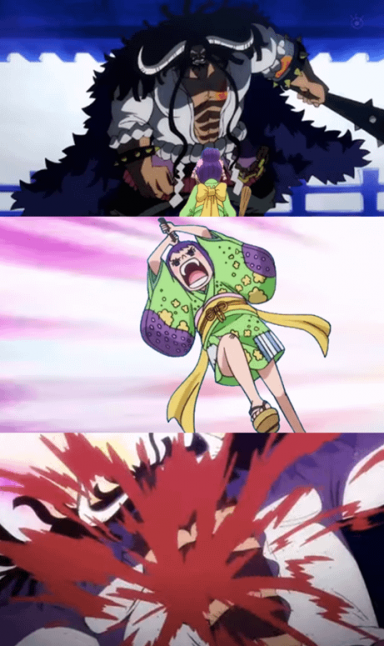
When you KNOW the author won't write zero consequences (concerning halfway important characters), there simply is no tension!
You can twist and turn, but all you're doing is coming up with a completely new, fictional definition of "tension" in order to fit your agenda that has nothing to do with actual tension.
When you try to use emotional and dramatic moments as tension only to then go on and destroy them again later (aka fake death scenarios), it destroys your credibility bit by bit. All those initially great moments look completely ridiculous and cringeworthy in hindsight.
The problem is that Oda has always done it, but post-skip it got more absurd each arc. We can bank on every single emotional (!) death scene being a fake-out, while the very rare actual deaths (Ashura Doji, Izou ...) are handled so anticlimatic and poorly, that everyone is asking themselves "Well, what? That's it?"
You can twist and turn, but all you're doing is coming up with a completely new, fictional definition of "tension" in order to fit your agenda that has nothing to do with actual tension.
When you try to use emotional and dramatic moments as tension only to then go on and destroy them again later (aka fake death scenarios), it destroys your credibility bit by bit. All those initially great moments look completely ridiculous and cringeworthy in hindsight.
The problem is that Oda has always done it, but post-skip it got more absurd each arc. We can bank on every single emotional (!) death scene being a fake-out, while the very rare actual deaths (Ashura Doji, Izou ...) are handled so anticlimatic and poorly, that everyone is asking themselves "Well, what? That's it?"

Oda simply do not give us easy answers. In that way, One Piece is an absolute iceberg, one of the deepest story I have had to analyze. EVER.
It's as generic a shonen as there is.
Slamming some seemingly "deep" themes like racism, slavery etc. on an incredibly formulaic and repetitive structure doesn't actually equal "deep", despite most not very educated fans believing that.
It simply means that Oda's macro-writing is solid to good, whereas his micro-writing is leaving a lot to be desired, even for shonen standards.
Overall it's a very nice read for kids/teenagers, that even adults can enjoy, if they don't care/think too much about the actual flaws in storywriting.
That's it though.
If One Piece is "one of the deepest stories" you ever read, you really need to step outside the children/teenager part of the library.
It's as generic a shonen as there is.
Slamming some seemingly "deep" themes like racism, slavery etc. on an incredibly formulaic and repetitive structure doesn't actually equal "deep", despite most not very educated fans believing that.
It simply means that Oda's macro-writing is solid to good, whereas his micro-writing is leaving a lot to be desired, even for shonen standards.
Overall it's a very nice read for kids/teenagers, that even adults can enjoy, if they don't care/think too much about the actual flaws in storywriting.
That's it though.
It's as generic a shonen as there is.
Slamming some seemingly "deep" themes like racism, slavery etc. on an incredibly formulaic and repetitive structure doesn't actually equal "deep", despite most not very educated fans believing that.
It simply means that Oda's macro-writing is solid to good, whereas his micro-writing is leaving a lot to be desired, even for shonen standards.
Overall it's a very nice read for kids/teenagers, that even adults can enjoy, if they don't care/think too much about the actual flaws in storywriting.
That's it though.

Getting invested with logiko
So maybe you're lucky again this time, but all in all he's quite funny to banter with.
I for one am really out for a while again though, just wanted to rant about this absolute horseshit writing from Oda!
Take care everyone!

When you KNOW the author won't write zero consequences (concerning halfway important characters), there simply is no tension!
I'm sorry but talking about a lack of tension while character get bodied left and right and the strongest characters get spiked like a sausage by a psychopath, is not something I can take seriously. If you have not felt any tension in the last 10 chapters and it is bothering you, well I'm sorry, but it is the sign that it is time to quit One Piece, quit whining and read another story.
You can twist and turn, but all you're doing is coming up with a completely new, fictional definition of "tension" in order to fit your agenda that has nothing to do with actual tension.
Most people are still enjoying the story my guy. You guyz are just trying to ruin the fun of everyone.
When you try to use emotional and dramatic moments as tension only to then go on and destroy them again later (aka fake death scenarios), it destroys your credibility bit by bit. All those initially great moments look completely ridiculous and cringeworthy in hindsight
So let me give you a little personnal insight: Do you know what I feel when I see Pell and Pound's (fake) death when I rewatch the anime?
I cry.
Strange, right? I know they are not dead, so why am I crying? Well let me give you a little author secret :
It's called empathy.
This is what you miss. I do not cry because of the death, I don't care about the death, One Piece is not game of throne. I cry because of what the death represents, because of what the character who witnesses or feel the death experiences or do not. Because of the thematic in place, because of the impact. This is what you people have locked yourself away from feeling. This is what makes a scene so great.
Death is only a plot point. A mear narrative tool. It is at best 50% of the job of a great moment.
When Kiku panics in front of Kanjuro and get stabbed, I don't feel because I'm afraid for her. I feel because of the despair SHE FEELS at this very moment. When Vivi loses Igaram, I do not feel horrified because of the loss of a great guy, I'm horrified by what VIVI HAS TO LIVE THROUGH.
This is the kind of feeling you block yourself from experiencing when you convince yourself that death are the epitome of tension.
Yeah, Oda makes a lot of fake death. So WHAT? Are any of those death removing what the characters are feeling in each one of these freaking moments ??? No. Absolutely not. In fact they magnify each one of those moment as they add a sense of relief by knowing that we will also be able to experience the return of the character.
One Piece is not demon slayer, it's not death note, it's not Attack on Titan, it's not Naruto. It has its OWN internal logic and its own way to make you feel things. But if you try to imprint on this story what others made you think is the norm, you will only block yourself from experiencing greatness.
Both at the moment of calm and tension. And you will only start to believe that ... what you read is not that deep.
If One Piece is "one of the deepest stories" you ever read, you really need to step outside the children/teenager part of the library.
It's as generic a shonen as there is.
It simply means that Oda's macro-writing is solid to good, whereas his micro-writing is leaving a lot to be desired, even for shonen standards.
Overall it's a very nice read for kids/teenagers, that even adults can enjoy, if they don't care/think too much about the actual flaws in storywriting.
The last time me and some others schooled him he had a crashout

Last edited:
Honestly, when I am reading my shounen, I usually expect main character to survive with their plot armour and I'm usually less interested in "will they survive or no" and more in "how the hell are they going to pull it". I guess in order to get immersion and see the full picture, you have to binge read arcs, instead of weekly, as this manga doesn't really translate well into weekly + frequent breaks schedule.
But even then, I am also not really interested in "how Luffy is going to win", because his fights are the worst thing happening in manga for me. I dislike looney tunes battle style, I dislike the rinse and repeat story beats, and I really cannot get excited about Luffy's battles since Nika emerged. I still liked his fight vs Katakuri, so it's not fair to say that I don't like any Luffy's fights post-TS.
I am still invested in Sanji's and Zoro fights.
But even then, I am also not really interested in "how Luffy is going to win", because his fights are the worst thing happening in manga for me. I dislike looney tunes battle style, I dislike the rinse and repeat story beats, and I really cannot get excited about Luffy's battles since Nika emerged. I still liked his fight vs Katakuri, so it's not fair to say that I don't like any Luffy's fights post-TS.
I am still invested in Sanji's and Zoro fights.
I guess in order to get immersion and see the full picture, you have to binge read arcs, instead of weekly, as this manga doesn't really translate well into weekly + frequent breaks schedule.
@Logiko I love one piece but I think we both have to admit that it is indeed too repetitive and simplistic sometimes. Most arcs follow the same structure
Can you tell me in which way Elbaph is similar to whole cake ?
How Wano is similar to Egghead ?
How Marineford is similar to sabaody?
How Water Seven is similar to Punk Hazard?
Etc.
The idea that there are recurring elements is true:
- New allies each island
- New thematics each island
- A separation
- People in distress
- An antagonist
- An impending doom, usually with a countdown
- A new hope with Luffy and a defeat leading to a liberation
All of this is true.. but all of this is also the usual structure of any shonen, not only that but it is also the logical result of a story of discovering, adventure and pirates...
You could of course create stories differently and One Piece actually does that very well, but One Piece requires a constant novelty and discovering but also a constant stream of the liberation thematic. SO each ones of this elements are fundamental bricks that requires a presence each arc. But they are not the structure, they are simple bricks. The structure of stories in One Piece varies greatly.
The skill of Oda, like any amazing artist, is to make you believe that his story is simple. The target audience of One Piece are young men between 12 and 17. Oda NEEDS this simplicity to appeal to his audience and make it understand the full scope of his story which he is delivering EXACTLY as he needs to on surface.
And on surface, One Piece indeed appear repetitive to the acid eye, but there is a real reason why the entire booktok and million of people taken over the story: One Piece is an iceberg of meaning and structure.
People often quote pre-timeskip to show the quality of the serie, but pre-timeskip is the where the structure is the most alike. Oda has been experimenting - literally - each arcs starting at Fishmen Island.
- Fishman Island is not so much of a struggle it's the depiction of the absolute superiority of the straw-hats, a reflexion of racism and destruction. It's a walk in the park, quite literally.
- Punk Hazard is surviving thriller.
- Dressrosa is a gladiator and survival game.
- Whole Cake is a bittersweet heist and escape musical.
- Zou is not even a conflictual arc, but a mystery story about the aftermath of a preceding event leading to incredible mythical revelations.
- Wano is an epic Samourai kabuki tale leading to a massive war mixed, for the first time, by outside worldbuilding events.
- Egghead is a Sci Fi siege and asset protection mission gone completely apocalyptic.
- And Elbaph? Well Elbaph is kind of the weirdest one thus far. The entire arc is like a big party gone wrong because of unintended guests. But you could say that it is a political debate about protectionnism and thus far, it has been very chaotic and do not ressemble any kind of arc we have been seeing.
What tension was ever in DBZ? Even death or blowing up planets were meaningless. Even the "Limits" of the Dragon Balls were constantly being broken.
The Dragon Balls aren't omnipotent. We already saw with Piccolo Daimao in DB that Shenron could be killed. We also saw, with Goku after the Frieza Saga and with the Androids at the end of the Cell Saga, that if someone is strong enough, Shenron cannot affect them against their will, whether that's moving them somewhere else or altering their biology. The Dragon Balls weren't there to defeat a villain. They were there to keep one from becoming too strong or immortal, and only in a second phase were they used for "resetting" the arc's damage back to a status quo.
Arcs in DBZ have a simple layout: a villain is introduced at the beginning; by the end of it, Goku will defeat him. That's the simple premise. That's the shounen standard, used by One Piece itself.
So tension comes from altering everything in-between those stages. Stakes are built on our fear, as the reader, that characters might lose something or someone before Goku dispatches with the villain.
---
Raditz comes, fights Goku and Piccolo, and dies taking Goku with him.
The deus ex machina of the Dragon Balls will bring Goku back to life. But it's that very safety net that attracts Vegeta and Nappa to Earth, two threats way bigger than Raditz was on his own.
Goku trains in the Afterlife and rushes back to deal with the Saiyans. You know from the arc formula that he will defeat them once he gets there.
So tension is injected before that.
By the time Goku makes it to Earth, Tien and Chiaotzu have died. It's Chiaotzu's second death at that, so he won't be brought back. Not only that, but even if he could be brought back a second time--Piccolo has also been killed, and with him the Dragon Balls are gone.
We're 1/2 into the arc and the deus ex machina is already out of the picture.
Then Goku arrives, dispatches of Nappa, beats Vegeta's ass.
But Vegeta has an ace up his sleeve. Even with Kaioken Goku still can't win against his Ape form.
It's only thanks to Gohan, Krilin, and Yajirobei that the planet is saved--and here already Toriyama is tweaking his formula.
Next arc, you know that once Goku arrives on Namek he will fight and defeat Frieza.
That's set in stone.
So Toriyama plays with tension by having weakling duo Gohan and Krilin be the main protagonists, both running away from Frieza's overwhelming forces, and trying to navigate around Vegeta's backstabbing nature.
And when Goku finally lands on Namek?
Gohan is paralyzed. Krilin is about to be killed. And even after taking care of the Ginyu squad, Goku still needs more recovery.
Then comes Frieza. Everything they throw at him doesn't phase him. His transformations seem endless and any technique the DBZ fighters use is meaningless. Even the genkidama isn't enough. Piccolo almost dies. Vegeta dies. And then Krilin dies.
And it's his second death at that--so he won't be back.
That's what pushes Goku to turn Super Saiyan.
And even after the transformation, the story doesn't play it safe. The tension keeps rising, with Namek's imminent explosion and Goku's search for a spaceship to leave the planet in time.
Next arc.
Goku is away. Frieza, who's been shown to be nigh unstoppable, appears on Earth. Not only that, but there's TWO of them. And Vegeta, who's the strongest character on the protagonist's side around, knows that he can't handle them.
Again: we know that once Goku makes it to Earth, he will manhandle Frieza. But what will the price of his tardiness be? What will Frieza destroy, who will he kill?
That's rising tension over and over in just two chapters.
Then a stranger appears out of nowhere and with ease kills both Frieza and his dad.
Not only that, but this stranger comes from the future and informs them of higher threats than Frieza himself, threats who have killed everybody in the future.
The DBZ fighters train for two years:
and still Yamcha dies
and still Goku is defeated by #20 and almost dies to the heart disease
and still Gero gets away.
And as if that wasn't enough?
Trunks tells them that these weren't the androids he warned them about.
And then Trunks finds someone else who's come back from the future.
And that his future self has been killed by this someone.
And a weird bug monster starts sucking up lifeforms left and right, creeping out even Kami.
Stakes are introduced within this new web of characters, with the fate of the planet (and the very galaxy) being in the background, while the foreground focuses on the interpersonal and the psychological. Cell becomes perfect because of Krilin's heart. Cell becomes perfect because of Vegeta's pride. Each of those variables adds uncertainty in the reader, because the characters aren't acting according to plot, but according to their own characterization, which can lead to unexpected developments.
Even in the last act of the arc, when things revert to the familiar martial tournament, a format that lets us know that Goku will fight and defeat Cell by the end of it, Toriyama still shakes things around.
Goku gives up.
There's tension as Gohan tries to live up to the expectations.
There's tension as Goku realizes his own misreading of Gohan's character, and has to die for it.
There's tension as Cell returns even stronger than before, and begins killing every DBZ fighter left.
It's not the Dragon Balls that save the day. They aren't the undo button to cancel the arc's consequences. They merely restore the planet, but don't wipe away the relationship changes generated by the Androids' plot.
Goku is still gone.
Gohan is still expected to be more than he can be.
#18 is still treated as a person and not a machine.
The arc has provided growth that doesn't get waved away.
Even the Buu Saga, which starts with a lighter tone, and where stakes don't really become tangible until Vegeta kills himself, tension rises beyond previous limits.
Blowing up planets is meaningless? Here's a character who can erase entire galaxies at once.
Death is meaningless? Here's a character who comes to the Afterlife, who scares the gods themselves, and who threatens to erase a soul once and for all--no do-over, no resurrection. A character who's never been defeated, merely sealed away.
That is the apex of stakes in the DBZ universe. You can't go much higher than this: that's why the sequels had to introduce multiverses and more separate future timelines.
Buu is the be-all and end-all, and from Oolong's introduction to Buu's demise, Toriyama constantly ups the ante and tweaks what characters care about, what they can lose, what they have to lose in order for the story to still generate emotional investment.
And Naruto never had any Stakes. Even things like not being able to Use the Wind Rasengan-Shuriken because it was too damaging to Naruto was gone by the next arc with a new power up. So what stakes were there?
The Sasuke-Naruto bromance is the main engine of tension of the story. That's why the highest point of engagement is with their fight at the Valley of the End, where Naruto fails to defeat or convince Sasuke.
The first half of the story is masterfully built on cause-and-effect, on unescapable choices that leave a mark on the characters for the rest of the series.
If Naruto wants to be ninja, he will have to stop, even kill, tragic people like Zabuza and Haku.
If Sasuke wants power, he will have to subjugate himself to monsters like Orochimaru.
If Naruto wants to save Sasuke, he will have to give up control to the kyuubi.
If Naruto wants to be a good hokage, he will have to not make Gaara's own mistakes and let grief consume him.
That's why I said that Nagato shat the bed.
Up until the end of the Pain Arc, Naruto the manga has flawless execution of pay-and-reward. Characters go through trials, pay a heavy price, and come out changed for the better or the worse. Nagato's undoing the Leaf destruction takes away part of the good faith the audience has in the author to deliver on set-ups and payoffs without cheating.
From the Pain Arc onward, the reader becomes like you, Dettles: he starts asking what's the point of all the new conflicts if everything can be handwaved away with a single technique. Naruto remained the same in that arc. The Leaf remained the same. (Sure, Naruto couldn't become the leader of the Leaf if there is no Leaf, but Kishimoto wrote himself in that corner.) Only Nagato was changed by it--and he dies.
At least Jiraya wasn't brought back.
By the Ninja War, no matter what stake Kishimoto introduces, it's no longer credible because there is this precedent that the slate will be wiped clean. The whole ninja alliance gets godly chakra from Kurama outta nowhere? And dumb Neji still dies? No wonder it felt unreal to many, expecting to see him brought back to life by some Rinnegan bullshit.
-------
One Piece follows the DB formula: by the end of the arc, Luffy will have defeated the villain. That's a given. Tension is built before that, focusing on what the characters may lose, in terms of material possessions, relationships, or health, before that point.
You don't feel tension in Drum Island because Wapol is strong: far from it. You feel tension because of Chopper and Hiluluk's relationship. You feel tension because Wapol wants to erase Hiluluk's flag. You feel tension because Wapol has stripped the country of doctors in the one arc where Nami is sick and Sanji is bleeding and Luffy is about to die from hypothermia.
Alabasta is the first arc where Oda goes all-out on stakes. We've been with Vivi for four storylines now, we care for her, we want to see her and her people free. The Strawhats care for her. Hell, we get one of the series' most iconic images, with the Xs on each member's arm, thanks to Vivi.
We slowly learn about Baroque Works' plan.
We learn about Croc's identity.
We're captured alongside Smoker.
We see all the agents who need to be defeated in order to stop Croc's plan.
We even see Luffy be defeated over and over.
And once he finally succeeds?
Croc still has a backup plan and a timebomb will kill most of the population.
And Pell has to sacrifice himself to stop it.
(Which gets undone and leaves a sour taste in many readers' mouths, but everything up to that epilogue is done perfectly).
Enel's destruction of the Upper Yard follows the same pattern on an even larger scale.
In Water 7, Oda mines the crew itself for stakes:
the Merry is being abandoned
Luffy and Usopp have a falling out
Robin leaves the crew.
It all happens so quickly, the reader is thrown for a loop. For the first time in the series, the future of the crew is unknown.
And this is only the setup of the arc.
Luffy and Zoro get easily defeated. Sanji goes on a solo mission to rescue Robin; rescues Franky, is helped by Usopp, and almost succeeds in getting Robin back, before things escalate again.
Even once Robin is back with the crew, at the climax of the arc, and Usopp has to infuse Luffy with a healthy dose of willpower, stakes are still being raised with Lucci promising to go apeshit on Luffy's crewmates, with the Buster Call being called by mistake, with the SHs being surrounded on all sides and with apparently no way out.
You can call the Merry's last-minute arrival an asspull, but it worked magnificiently in conveying the arc's message ("We're crewmates to the very end."). That's an arc with repercussions for the series as whole. The arc that rounded Robin's character, that introduced Usopp's persona (before Usopp as a whole was abandoned), the arc that redefined the relationships between captain, vice captain, and potential crewmates.
Water 7 is the perfect OP arc in terms of stakes, which is why Oda replicates it again with Ace.
The crew is defeated on Sabaody. Every SH is on their own. Anything can happen. As if that weren't enough, Luffy's brother is being scheduled for an execution.
Cue Impel Down: by the end of the arc, we know that Luffy will succeed in breaking his brother out of the prison.
Or not.
He was too late, and now Ace's been taken to Marineford.
So to Marineford we go.
By the end of the arc, we know that Luffy wil succeed in saving Ace from being executed.
Or not...
Misery and misery, defeat after defeat. That's what makes this stretch of the story so rewarding. Oda sets up obstacles; whenever Luffy fails to clear them, a heavy price is paid.
Oda tried once more to replicate the structure in WCI, but by then the overall writing had become much weaker than it was pre-timeskip.
In FMI he could only inject tension through the overused timebomb plot that was the Noah Arc, and by having Luffy bleed out for narrative purposes.
In PH people constantly run around just to run around. There's nothing at stake, not even with Caesar demonstrating his WMD.
DR has another timebomb, and an entire island of people cheering live on Luffy to win against the villain. There is no secret scheme, no backup plan. Nothing that could surprise us or the characters. The SHs defeat their opponents. Luffy defeats Doffly. Cut and clean.
WCI has a healthy dose of tension thanks to Katakuri and even to Pedro's kamikaze ploy. Things are again dire, we see a Yonko's fleet posing a real problem... up to the point where a crazed all-out BM lands on the Sunny... and nothing happens. Nobody is injured, nothing is irredeamably damaged. No everlasting consequence on the story as a whole. Wadatsumi pukes out a Sunny decoy to fool the BMP; the Sunny makes away without a scratch. The end of the stakes.
Then comes Wano.
The SHs enter a country that cannot be entered--and pay no price.
The SHs and the Scabbards are allowed to travel openly and to conspire against the government--and pay no price.
Kaido meets Tama--and pays no price.
Momo is magically aged up to be able to control his faulty fake DF (which turns out to not be faulty at all)--and pays no price for the sudden power boost, not even a little panel of him commiserating his wasted youth.
Even when the villain does something useful, like capturing and executing Yasue, the event is still turned in the protagonists' favor.
Luffy is imprisoned? Free training.
The Scabbards had a traitor? Well, so did Orochi's court.
At every step of the story, everything that could work in the SHs' favor does. They lose nothing, they are surprised by nothing. Even the ice zombie virus is merely a sideplot to keep Chopper occupied. There is an easy counter to Kanjuro's fire demon. The villain's daughter is fighting for the good guys. The eight-headed dragon serpent is defeated by easily cutting off his head. BM goes retarded and helps the SHs, before getting more retarded and falling to Kid and Law. Why were so many readers expecting the raid to fail? I couldn't tell--this is such a compelling story filled with ups and downs.
Even when the arc hits its lowest low, narratively speaking, and the WG sabotages Luffy so that Kaido can kill him... surprise, motherfucking giant infodumping elephant is here to let us know that god is back. And there emerges Nika, fully stretching the stakes down to hell.
In Egghead, you have:
1. the fastest Admiral on earth;
2. a demon capable of popping up heads with his gaze;
3. CP0's best assassins, two of which awakened zoans;
4. the WG's strongest engineered unit.
And still the SHs never lose anything, aren't even injured in any meaningful way, and the only ones who die are clones of the one guy who realized he'd made a mistake of creating those clones in the first place.
Now Elbaf is giving up the King of the World, the devil himself, who can't even hurt a little child. Luffy gets impaled twice while the SHs are working the hairdryer on a frozen chick, and Zoro and Sanji exchange one-liners with their opponents in no rush to finish the fights. Even Aokiji's entrance at the end of the Long Ring Long Land arc generated more apprehension in the crew.
-----
Bleach starts strong: having the Soul Society arc revolve around Rukia's execution helps gradually raise the stakes. Having Ichigo fail to stop the plan, and revealing the mastermind behind it, and having him get what he was after all along? Perfectly executed escalation. And we get drawned-out fights for most of the arc.
Then Kubo repeats the same plot with Orihime in Hueco Mundo. And we get drawned-out fights for most of the arc.
Then a whole human city is substituted with a fake one to avoid senseless distruction, taking away from the stakes that a massive war within a human settlement could generate. And we get drawned-out fights for most of the arc.
Then a villain appears with the power to rewrite anybody's past and make himself their friends and most trusted person at will--and Kubo does fuck all with it, when that's the sort of paranoia-fueling power that could hold an entire series on its back.
Supreme God Yacht Boat dude is more of the same, and the last arc is nothing but "who can make the enemy think they're hit while preparing a secret from-behind counter-hit" for chapters and chapters at a time.
Last edited: