Speculations Help , Zoro's next powerup could be hidden in this "Rakugo"
- Thread starter Kurozumi Giggio
- Start date
More options
Who Replied?
Well first off, great topic idea and phenomenal find. I really like the art of Rakugo but never look them up or anything.
Immediate takeaway from your video: the Shinigami made the man able to see reapers. Reaper at the head means your time is up, reaper at the feet? Any serious illness can go away when the reaper is made to leave.
:cheers:
I don't know if Oda will reference this but that's great to chew on.
As for Hell Hakkei, here's a translated wiki:
Here is a link to the Japanese Rakugo. There's an extensive transcript but my phone isn't letting me copy for translation
Immediate takeaway from your video: the Shinigami made the man able to see reapers. Reaper at the head means your time is up, reaper at the feet? Any serious illness can go away when the reaper is made to leave.
:cheers:
I don't know if Oda will reference this but that's great to chew on.
As for Hell Hakkei, here's a translated wiki:
" Jigoku Bakei Moja no Tawamure" is one of the Kamigata rakugo plays. "Hakkei" is read as "bakkei" instead of "hakkei". In Edo Rakugo , it is called " Hell Tour ".
Overview
It was classified as a travel story, and was sometimes incorporated into a part of " Ise Sangu Shinnobu ", also known as "East Journey". The name can be seen in one of the " light work ").
It takes more than an hour to play through, and there are many gag with current affairs throughout the whole story, and there are many productions with gestures, so it is a big story that requires considerable ability from the speaker.
It is a program whose origin can be determined during the Tenpo era, and according to the United States and North Korea, it is the oldest one that appears in a small book called "Hanashi no Seed" by Anyuyama , published in 1839 . In the prewar period of the Showa era, the 5th Shokaku Shofukutei Matsuzuru (titled "Yajiki Kita Hell's Journey". SP records remain) and the 3rd Shokaku Shofukutei Fukumatsu and others only reported. Today's "Hell Hakkei" was taught by Fukumatsu around 1954-55 ( I went to see Fukumatsu performing in Kyoto in the era like the house of the second generation of Kamigata , but in the late years. It was difficult to hear because it was an oral performance), and it is based on the reconstructed one. In Tokyo, there is a recording of the 4th generation Enyu (Isao Kato) as the story of Sanyutei Enyu generations ("Hell Tour"), but the content is slightly different and the required time is short.
It is roughly divided into the first half and the second half. First, Kiroku , who died after eating mackerel sashimi , reunites with the retreat of Iseya, who died earlier on the journey to Meiji. Next to the two, a group of young husbands with geisha, maiko, Nakai, and Taikomochi appears, and the familiar hellish scenery such as Sagamigawara, Sanzugawa crossing, Rokudo Tsuji, and Enma 's office is depicted while the characters are replaced. In addition to Kiroku, who first appears, it is about the first half that the decision of King Enma is given to everyone in the line.
According to the ruling of King Enma, four men from all of them went to hell, and the latter half is the story of those four and the demons and enma of hell. All four of them are all musicians, and they use their hands to annoy the demons.
Sage
The usual sage "Drink the Great King" is applied to the Chinese herbal medicine Daio, which has a laxative effect and is also used as a constipation drug, but it may be difficult to get used to, and Shijaku Katsura said, "If you lie, you will be the Great Enma in hell." It is changed to a laxative based on the warning phrase "I can pull out my tongue."
variations
The scene where the daughter of the teahouse on the banks of the Sanzu River talks about the half-life of the old woman of the Sanzu River and the transition of the ferry, and the scene of the riverside of Sagami, are easy to put in a gag that reflects the social situation. In the US and North Korea, portliners and water rides were introduced in the case of ferryboats, and in the oral performance in Kyoto in 1990 (included in the daily broadcast "Specialty !! It was likened to Kyoto Arashiyama .
In Tsuji of Rokudo, the main street of hell, "Meidosuji" runs, and there are many playhouses and vaudeville seats. It is a miso of Midosuji, and it is a miso that is intentionally pronounced so that it can be heard in either direction . Nostalgic eastern and western masters line up at the yose here. The United States and North Korea gave their name here and tickled " coming soon" Komaicho (currently the 5th generation Katsura Beichou ) , the son of the U.S.A. In fact, at the performance of Dorakutei the day after the U.S.A. entered the demon register, Beichou Katsura played the first half of this performance and made it appear in the story as "Katsura U.S.A., coming today"
Also, in the Edo Rakugo "Jigoku Meguri", especially when a veteran rakugoka spoke, there was a scene in which the 7th generation Danshi Tatekawa appeared and ridiculed.
In the sketch of "Paper Bridge" that can be seen on the way to the Enma's office, U.S.A. and his disciple, Katsura Kitchō , give the name of a popular rakugoka at the time of the oral performance , and it collapses when the sin of the person who crosses is heavy, not the weight. The characteristics of the bridge, which is said to be, are described here, but for comparison, the 3rd generation Katsura Bunga and the 2nd generation Katsura Shuncho, who were slim and competed for one or two among the Kamigata hanashi , were introduced and laughed.
The scene in which Enma the Great appears in a terrifying form is a symbol of this performance, such as decorating the jacket of a CD / DVD, but the baby-faced Shijaku Katsura dared to appear with a gentle expression. In addition, after showing Enma's face in the US and North Korea, he hides his face with one hand and tickles, "If you do this, your face will not return to its original state for a while."
At the one-art show at the Enma Agency, Shijaku played an animal impersonation, and Kitchō played a senior rakugo storyteller, such as his teacher, Beichou Katsura, with a debayashi in raku .
Known as the 18th of the 3rd generation Katsura Beichou . The first full-length broadcast was shown on March 1, 1962 (Showa 37) on Asahi Radio Broadcasting , which was publicly recorded on February 23 at the "21st Kamigata Rakugo Kikukai " sponsored by the same station . The U.S. and North Korea stopped performing the " Iruru Masaoka 33rd Anniversary Performance" ( Iino Hall , Tokyo ) in November 1990, but instead, the middle-aged generation centered on the U.S.A. Increasingly, we are trying to step up to.
Other than Kitchō Katsura, Shijaku Katsura, and Kitchō Katsura, the oral performances of Bunchin Katsura, Bunga Katsura 4th, Jakujaku Katsura , Kujaku Katsura , and Kichiya Katsura are known. In November 2010, the 4th generation Hayashiya Somemaru played the Somemaru version with his own interpretation at the "Somemaru Tokusen Rakugo", and Jakuzaku played "Super Rakugo" with a set of hell in Takaza. There is. Kujaku premiered Saddle with a unique style of playing not only the shamisen but also the marimba.
Katsura Bunshi, the 6th generation , is making his own adaptation of "Hell Hakkei Yasushi Hen", which features Yasushi Yokoyama , as one of the original rakugo stories.
References
There is a stage "Hell Hakkei ... Ukiyo Hyakukei" directed by Hiroaki Higashino , which features many Kamigata rakugo plays based on this program .
In addition, there is a work based on this program, " Jigoku no Sobee " by Yukihiko Tajima and its series.
In the mid-1960s, when the 3rd generation U.S.A. played "Hell Hakkei" in Tokyo for the first time, the 6th generation Matsuzuru's " Rakuda " was also played at the same time. It was something that impressed me. At that time, Tsuruo Ando was in a state of excitement, saying, "There is a great storyteller above."
At the Japan Science Fiction Tournament (SHINCON) held in Kobe in 1975, Beichou Katsura, the third generation, talked about this in front of about 1,000 science fiction fans.
In February 2016, it was made into a play at Osaka Shochikuza under the title of "Katsura Beichou Katsura Beichou Katsura Beichou Katsura Beichou Katsura Beichou Katsura Beichou Katsura" . The cast will include the 2nd generation Katsura Zakoba , the 3rd generation Katsura Nankô , and the 3rd generation Katsura Kyoko (3rd generation Katsura Suzume ) . The script is written by Sadao Osada , a rakugo writer who had a close relationship with the United States and North Korea, and directed by Masafumi Saito of Warabi - za
Hirofumi Tanaka 's "Hell Hakkei" is a collection of short stories with various stories set in the world of rakugo hell.
In 2018, it was staged under the title of "ANOTHER WORLD" in the Takarazuka Revue Star Troupe .
Overview
It was classified as a travel story, and was sometimes incorporated into a part of " Ise Sangu Shinnobu ", also known as "East Journey". The name can be seen in one of the " light work ").
It takes more than an hour to play through, and there are many gag with current affairs throughout the whole story, and there are many productions with gestures, so it is a big story that requires considerable ability from the speaker.
It is a program whose origin can be determined during the Tenpo era, and according to the United States and North Korea, it is the oldest one that appears in a small book called "Hanashi no Seed" by Anyuyama , published in 1839 . In the prewar period of the Showa era, the 5th Shokaku Shofukutei Matsuzuru (titled "Yajiki Kita Hell's Journey". SP records remain) and the 3rd Shokaku Shofukutei Fukumatsu and others only reported. Today's "Hell Hakkei" was taught by Fukumatsu around 1954-55 ( I went to see Fukumatsu performing in Kyoto in the era like the house of the second generation of Kamigata , but in the late years. It was difficult to hear because it was an oral performance), and it is based on the reconstructed one. In Tokyo, there is a recording of the 4th generation Enyu (Isao Kato) as the story of Sanyutei Enyu generations ("Hell Tour"), but the content is slightly different and the required time is short.
It is roughly divided into the first half and the second half. First, Kiroku , who died after eating mackerel sashimi , reunites with the retreat of Iseya, who died earlier on the journey to Meiji. Next to the two, a group of young husbands with geisha, maiko, Nakai, and Taikomochi appears, and the familiar hellish scenery such as Sagamigawara, Sanzugawa crossing, Rokudo Tsuji, and Enma 's office is depicted while the characters are replaced. In addition to Kiroku, who first appears, it is about the first half that the decision of King Enma is given to everyone in the line.
According to the ruling of King Enma, four men from all of them went to hell, and the latter half is the story of those four and the demons and enma of hell. All four of them are all musicians, and they use their hands to annoy the demons.
Sage
The usual sage "Drink the Great King" is applied to the Chinese herbal medicine Daio, which has a laxative effect and is also used as a constipation drug, but it may be difficult to get used to, and Shijaku Katsura said, "If you lie, you will be the Great Enma in hell." It is changed to a laxative based on the warning phrase "I can pull out my tongue."
variations
The scene where the daughter of the teahouse on the banks of the Sanzu River talks about the half-life of the old woman of the Sanzu River and the transition of the ferry, and the scene of the riverside of Sagami, are easy to put in a gag that reflects the social situation. In the US and North Korea, portliners and water rides were introduced in the case of ferryboats, and in the oral performance in Kyoto in 1990 (included in the daily broadcast "Specialty !! It was likened to Kyoto Arashiyama .
In Tsuji of Rokudo, the main street of hell, "Meidosuji" runs, and there are many playhouses and vaudeville seats. It is a miso of Midosuji, and it is a miso that is intentionally pronounced so that it can be heard in either direction . Nostalgic eastern and western masters line up at the yose here. The United States and North Korea gave their name here and tickled " coming soon" Komaicho (currently the 5th generation Katsura Beichou ) , the son of the U.S.A. In fact, at the performance of Dorakutei the day after the U.S.A. entered the demon register, Beichou Katsura played the first half of this performance and made it appear in the story as "Katsura U.S.A., coming today"
Also, in the Edo Rakugo "Jigoku Meguri", especially when a veteran rakugoka spoke, there was a scene in which the 7th generation Danshi Tatekawa appeared and ridiculed.
In the sketch of "Paper Bridge" that can be seen on the way to the Enma's office, U.S.A. and his disciple, Katsura Kitchō , give the name of a popular rakugoka at the time of the oral performance , and it collapses when the sin of the person who crosses is heavy, not the weight. The characteristics of the bridge, which is said to be, are described here, but for comparison, the 3rd generation Katsura Bunga and the 2nd generation Katsura Shuncho, who were slim and competed for one or two among the Kamigata hanashi , were introduced and laughed.
The scene in which Enma the Great appears in a terrifying form is a symbol of this performance, such as decorating the jacket of a CD / DVD, but the baby-faced Shijaku Katsura dared to appear with a gentle expression. In addition, after showing Enma's face in the US and North Korea, he hides his face with one hand and tickles, "If you do this, your face will not return to its original state for a while."
At the one-art show at the Enma Agency, Shijaku played an animal impersonation, and Kitchō played a senior rakugo storyteller, such as his teacher, Beichou Katsura, with a debayashi in raku .
Known as the 18th of the 3rd generation Katsura Beichou . The first full-length broadcast was shown on March 1, 1962 (Showa 37) on Asahi Radio Broadcasting , which was publicly recorded on February 23 at the "21st Kamigata Rakugo Kikukai " sponsored by the same station . The U.S. and North Korea stopped performing the " Iruru Masaoka 33rd Anniversary Performance" ( Iino Hall , Tokyo ) in November 1990, but instead, the middle-aged generation centered on the U.S.A. Increasingly, we are trying to step up to.
Other than Kitchō Katsura, Shijaku Katsura, and Kitchō Katsura, the oral performances of Bunchin Katsura, Bunga Katsura 4th, Jakujaku Katsura , Kujaku Katsura , and Kichiya Katsura are known. In November 2010, the 4th generation Hayashiya Somemaru played the Somemaru version with his own interpretation at the "Somemaru Tokusen Rakugo", and Jakuzaku played "Super Rakugo" with a set of hell in Takaza. There is. Kujaku premiered Saddle with a unique style of playing not only the shamisen but also the marimba.
Katsura Bunshi, the 6th generation , is making his own adaptation of "Hell Hakkei Yasushi Hen", which features Yasushi Yokoyama , as one of the original rakugo stories.
References
There is a stage "Hell Hakkei ... Ukiyo Hyakukei" directed by Hiroaki Higashino , which features many Kamigata rakugo plays based on this program .
In addition, there is a work based on this program, " Jigoku no Sobee " by Yukihiko Tajima and its series.
In the mid-1960s, when the 3rd generation U.S.A. played "Hell Hakkei" in Tokyo for the first time, the 6th generation Matsuzuru's " Rakuda " was also played at the same time. It was something that impressed me. At that time, Tsuruo Ando was in a state of excitement, saying, "There is a great storyteller above."
At the Japan Science Fiction Tournament (SHINCON) held in Kobe in 1975, Beichou Katsura, the third generation, talked about this in front of about 1,000 science fiction fans.
In February 2016, it was made into a play at Osaka Shochikuza under the title of "Katsura Beichou Katsura Beichou Katsura Beichou Katsura Beichou Katsura Beichou Katsura Beichou Katsura" . The cast will include the 2nd generation Katsura Zakoba , the 3rd generation Katsura Nankô , and the 3rd generation Katsura Kyoko (3rd generation Katsura Suzume ) . The script is written by Sadao Osada , a rakugo writer who had a close relationship with the United States and North Korea, and directed by Masafumi Saito of Warabi - za
Hirofumi Tanaka 's "Hell Hakkei" is a collection of short stories with various stories set in the world of rakugo hell.
In 2018, it was staged under the title of "ANOTHER WORLD" in the Takarazuka Revue Star Troupe .
Well first off, great topic idea and phenomenal find. I really like the art of Rakugo but never look them up or anything.
Immediate takeaway from your video: the Shinigami made the man able to see reapers. Reaper at the head means your time is up, reaper at the feet? Any serious illness can go away when the reaper is made to leave.
:cheers:
I don't know if Oda will reference this but that's great to chew on.
As for Hell Hakkei, here's a translated wiki:
Here is a link to the Japanese Rakugo. There's an extensive transcript but my phone isn't letting me copy for translation
Immediate takeaway from your video: the Shinigami made the man able to see reapers. Reaper at the head means your time is up, reaper at the feet? Any serious illness can go away when the reaper is made to leave.
:cheers:
I don't know if Oda will reference this but that's great to chew on.
As for Hell Hakkei, here's a translated wiki:
Here is a link to the Japanese Rakugo. There's an extensive transcript but my phone isn't letting me copy for translation
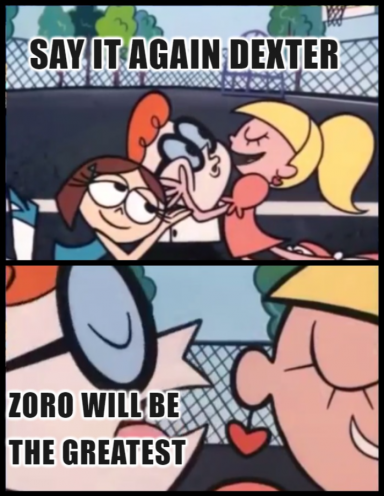
thanks i couldn't find this
The actual play is a little vague in connection from what I can find. Pain in the ass, really, for information in English. But I did find it interesting that act one had Zoro comment on the poisoned food, then act two had him eat the sashimi and black out during the fight with Killer, given the story of Kiroku and his trip to hell


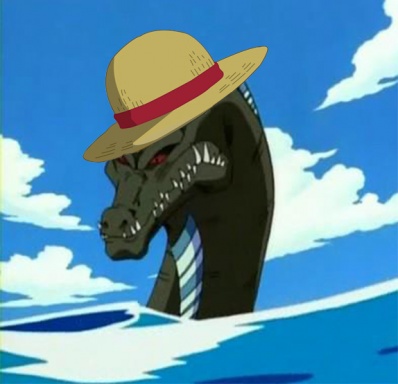
Immediate takeaway from your video: the Shinigami made the man able to see reapers. Reaper at the head means your time is up, reaper at the feet? Any serious illness can go away when the reaper is made to leave.
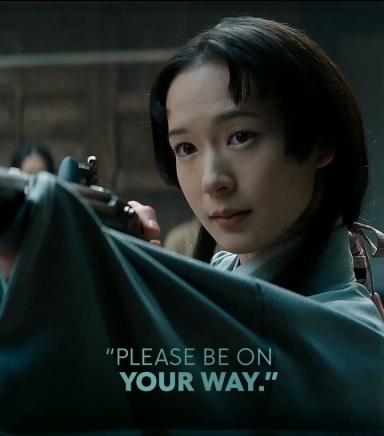

Didn't watch the video but if this is accurate then it gives the plot away, Zoro will be healed from a 2x Hakai? This ability would be more OP than half of the manga's devil fruits.
Didn't watch the video but if this is accurate then it gives the plot away, Zoro will be healed from a 2x Hakai? This ability would be more OP than half of the manga's devil fruits.
It's fifteen minutes and very fun if you have a chance to watch the video, but basically the story is about a man who's down on his luck, suicidal, and is approached by a reaper. The reaper tells him that he shouldn't die as his lifespan is very long, and gives him the power to see other reapers. He is told that a reaper presented at the foot of a potential victim (like Zoro himself) can be saved, no matter how dire the situation. But a reaper at the head of the potential victim means that they must die no matter what. Oda can pretty easily play with this if we look at the relationship and similarities between Zoro and Kaido
From both having suicide as an intro (Kaido's first appearance, Zoro's first appearance in Wano) to having attacks that reference the number 8 (such as in Hakkei, Bakkei, and Bagua) and so on.
i think the way Zoro gets back up is related to the end of the video , it says that you can't bring a dead person back to life unless you sacrifice another, Law maybe
i think the way Zoro gets back up is related to the end of the video , it says that you can't bring a dead person back to life unless you sacrifice another, Law maybe
[automerge]1648936163[/automerge]
He is told that a reaper presented at the foot of a potential victim (like Zoro himself) can be saved, no matter how dire the situation
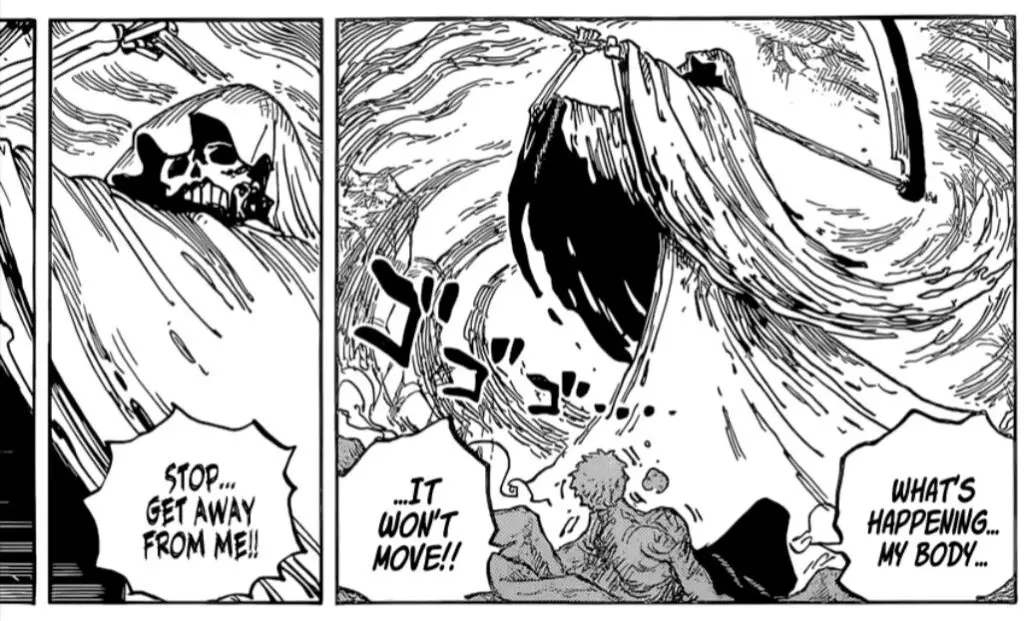
It's not the first time that Oda "spoils" stuff with his SBS answers.

W
Saw a bit, people that can see the Grim Reaper at someone's feet can do a spell and send it away and that person's illness disappears
when the sword accepts the wielder they become one , zoro's pain is his swords's pain and in the extreme conditions the swords take the swordman's pain , this would explain why roger and shanks don't have black swords
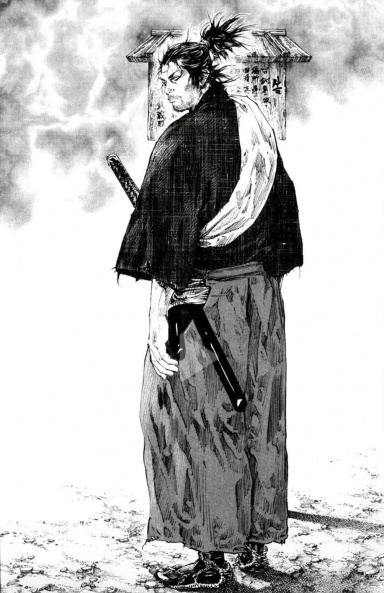
Said this a few months back. Can't think of what the power will be, just hope it ain't no looney toon stuff
[automerge]1648983199[/automerge]
What if Luffy can also see the reaper as he has died and come back? He's the one in a boisterous mood and it's said Joyboy brings joy to others. Somehow Oda makes him help Zoro through this little predicament and then Zoro helps him with his a la ZKK :cheers:
It's the "cursed" sword Enma's spirit. That's the only thing that makes sense.
The Mink Medicine making whoever takes it see illusions and being paralysed was never a thing. It also being Brook for some idiotic gag doesn't make sense either.
Either It's Enma or an actual spirit
An interesting tale 🤔
Zoro is most likely on the brink, I won't deny that cause everything that has happened. So this is most likely a Shinigami for the "King of Hell". He will 100% force this entity away by either making a deal with it or with his Conquerors spirit 🤔. As the chapter has also shown us, the Shinigami is in front of Zoro and not by his head, if it was it would confirm that he is in fact dying.
And just as the folklore states you can make deals with the Shingami and what does Zoro want? He wants Kaido's head. The unkillable Kaido as a price for the Shinigami in exchange for Zoro's life makes 100% sense. Plus he's already gotten the power to actually kill Kaido..."the power to slay a dragon with a single swing". His last swing missed on the Rooftop plus I doubt he would have killed Kaido with it but with AdCoC on 3 swords? Yeah he is killing Kaido
ZKK HYPE BABY!
The Mink Medicine making whoever takes it see illusions and being paralysed was never a thing. It also being Brook for some idiotic gag doesn't make sense either.
Either It's Enma or an actual spirit
An interesting tale 🤔
Zoro is most likely on the brink, I won't deny that cause everything that has happened. So this is most likely a Shinigami for the "King of Hell". He will 100% force this entity away by either making a deal with it or with his Conquerors spirit 🤔. As the chapter has also shown us, the Shinigami is in front of Zoro and not by his head, if it was it would confirm that he is in fact dying.
And just as the folklore states you can make deals with the Shingami and what does Zoro want? He wants Kaido's head. The unkillable Kaido as a price for the Shinigami in exchange for Zoro's life makes 100% sense. Plus he's already gotten the power to actually kill Kaido..."the power to slay a dragon with a single swing". His last swing missed on the Rooftop plus I doubt he would have killed Kaido with it but with AdCoC on 3 swords? Yeah he is killing Kaido
ZKK HYPE BABY!
Saw a bit, people that can see the Grim Reaper at someone's feet can do a spell and send it away and that person's illness disappears. Zoro can see the Grim Reaper, he just needs to find a way to send it packing and all of his pain will go away. There's also the new color cover with the words boisterous on Zoro's shirt, that means cheerful, energetic, etc. :cheers:
[automerge]1648936163[/automerge]
The Grim Reaper is at Zoro's feet.
It's not the first time that Oda "spoils" stuff with his SBS answers.
[automerge]1648936163[/automerge]
The Grim Reaper is at Zoro's feet.
It's not the first time that Oda "spoils" stuff with his SBS answers.
Last edited: