I think any attempt on building communism or anarchism, would have eventually failed... even if they looked like they had succeeded.
The major problem is that ALL of them are or had a very reduced and narrow minded vision of communism.
They saw "communism"
(I'll use the words for anarchism too) as a form of ideal or semi ideal classless and stateless society that would be created by creating a revolution or a slow revolution out of capitalism. The problem, and I keep repeating it on that thread :
Capitalism is just ONE of the major domination system on the planet. It is the one that binds the others, yes, but scrapping it away will not erease the others:
- Ableism/sanism
- Adultism
- Racism/white supremacy
- Patriarchy
These systems are OLDER than capitalism itself and most of them are most probably the result of the transition from Mesolithic age to the neolithic were sedenterisation took form and private property started to grow.
The major problem is that ALL the system function together and feed on eachothers thus reenforcing eachothers. I gave multiple example over the years, so a random example : Capitalism uses ableism to justify the marginalization of the individual considered as "unproductive". This marginalization serves as a leaver to rise the rest of society, as a tool of exploitation as a tool of self-alienation etc. The fact that people often throw at me the term "leach and parazite", is a result of that intersection of these two dominations.
Now, the bond between these system is too strong to attack them individually. Their strenght resides in their intersections and they will "heal" themselves naturally infinitely. For example, if you try to attack patriarchy through liberal means, you will create deconstructed men... but you will also give them more tools to uses their power within more progressive space (
this is why revolutionnary associations are currently thinking about prohibiting any forms of relationship in the movement between men and women in order to protect the later).
So, what to do?
We fight all these system at once by targeting their intersectionalities. Ergo... the name "
intersectionnal studies"... BUT there is another catch:
Most people are idealist, by that, we means most people will consider the "
individual within systems" rather than considering "
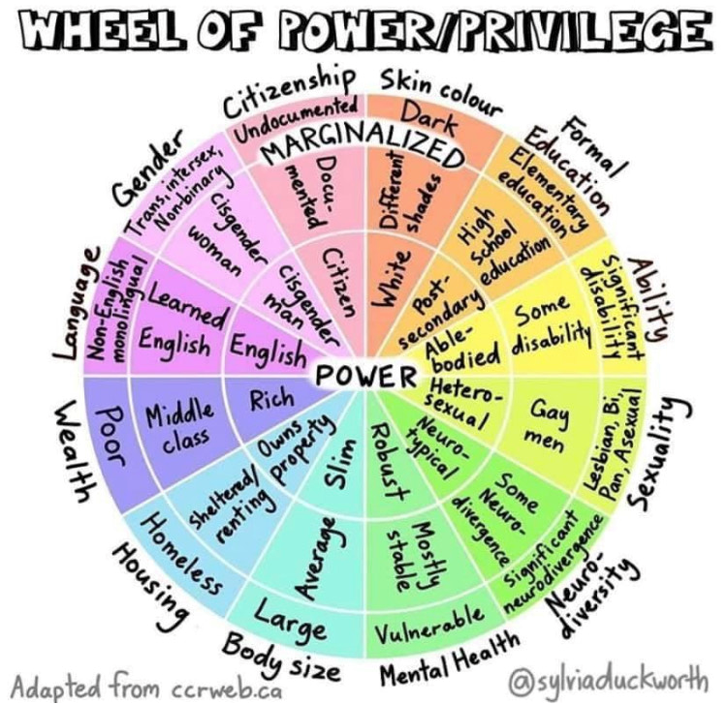
systems around individuals". When such mindset, usually called "liberal" on the left is used on intersectionnality, people tend to see intersectionnality like a form of individual oppressions that "stack up" over the life of a person like this:
The idea of this types of graphic -
that you will mostly see in the environment of a lot of leftist liberal feminists - is to say that for an individual.. the dominations can sometimes be combined and be "added up". As such we talk about an "intersection" of oppressions.
THIS IS WRONG
For many reasons that are a bit technical so I will simplify it like that :
It's depoliticizing and it individualize a systemic issue related to the place of people within the production.
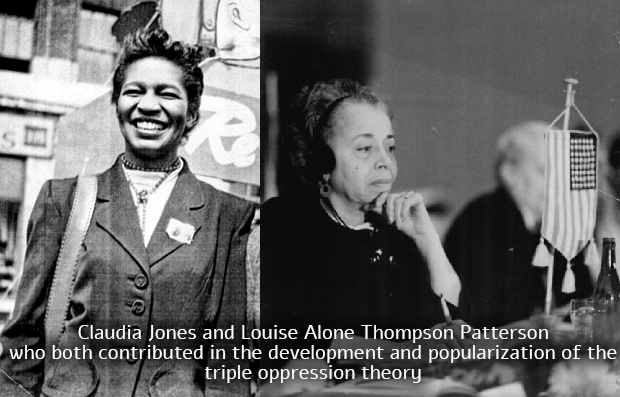
In reality this intersectionnal idea is much older than the liberal version we have today. Socialists like Claudia Jones theorized the concept of "
triple exploitation" back in the early 50'. A theory that seeked to explain the socio-economical status of black women in the US and how the interconnections between the different form of exploitation that are living these women create a specific form of oppression.
Triple exploitation appears in the intersection of three fundamental forms of exploitation:
Imperialism,
Capitalism and the
gender domination. (that you could call patriarchy now). Jones observed that women living in the intersection of these dominations were more susceptible to fall victim of something called "super-exploitation", a form of hardcore exploitation that are living marginalized.
"Super exploitation" is a form of socioeconomic structuration. It is something that capitalism needs in order to be maintained. For ex, (
and I'm quoting a sociology teacher here called Bad Socio - check him out) this is the creation of "organized abandonment spaces" like the Favelas or poor neighborhood, is a constant and a necessity for capitalism to organize control and the exploitation of these marginalized people.
As such, the question of gender is also important, because the structure that is family is ALSO an organ of capitalist and imperialist control. Through gender norms, we push for the perpetuation of the subjugation of women and the exploitation of both men and women in the capitalist and imperialist state. "men should provide, women should care" etc.
And the reality:
SO...
Intersectionnality should not be a framework and a analyzing tool where domination are considered to be addin up, it's a framework that allows us to understand how each intersections of each dominations will take different
SHAPES that will mutuallly feeding on eachothers and
transforms eachothers depending on the material conditions of existence and the place of the person within the production.
Therefore the best way to understand intersectionnality is not as a rosette, but as a variety of shapes and arrangements.. specific and different forms of "intersectionnalities" that are lived by an individual or a system.
It's a way to understand structures that could normally slipped away from our analysis.
Like that:
Note that I used the word "race" and not "ethnicity" specifically because the word "ethnicity" depoliticize and therefore invizibilize the "racialization" process that I explained many times already.
2 examples :
- Two white women.
For that case, A liberal progressive and idealist leftist (
in the philosophical meaning always) will usually consider that these two person will face the same domination :
Patriarchy. Leftists will therefore tend to push the necessity of lifting up both of these women out of their patriarcal domination, and usually, in the liberal sense, by individualizing the problem : "
you must be a girl boss" "
don't trust men" "
be your own woman" rather that looking at it systematically (
the men's who have created a system of domination) etc.
PROBLEM: Most people will negate the class, now let's say that one woman is from the working class and the other her domestic helper... things take a very different shape.
Now, we can see that while one woman is indeed facing patriarchy, the other is also facing a domination of class. Within an intersectionnal framework, this analysis allows us to understand that the second women will face DIFFERENT forms of domination relative to the first woman coming from the upper class. (for example, patriarchy for women in the working class will hit a LOT harder and will be present in a lot of different forms that won't bee analyze with the case of the rich women (
for example, the access of care will be different, the imapct of patriarchy in working spaces will also take a differnt form, in this case much harder....)
- A black man and an "asian" woman (in the west)
, both on the working class:
Again, an liberal approach would tend to make us approach intersectionnality based on the additions of domination and through a form of comparizon. In this case, the asian woman not only face capitalism and patriarchy, but also racialization, and the black man is only facing racialization and capitalism, so a liberal would tend to say "the asian woman is facing "more" dominations that the black man". And it wouldn't be completely wrong...
BUT
It would prevent us from looking at the MATERIAL REALITY of the living conditions of both people. In our case, asian communities in the west are usually considered "examplary", it's a sneaky form of racialization linked to whiteness (that I explained before) that pushes racialized people to seek a form of "examplarity" to access whiteness and therefore access to the society the same way a white person can. In this case, not only would it be wrong to hierarchize the dominations faced by the two people (
since they are different, not worse or better), but it would also prevent us from seeing that black people in the working class, will usually face an amplified form of racialization by the institutions and racists, creating a different FORM of oppression. depanding on their lives and place in the production chain and class.
--
As you can see - if you read all of that and followed - intersectionnality is the MOST POWERFULL tool to analyze dominations.
And combined to a materialist approach... it allows us to clearly define how we should fight each dominations systems and each of its agents.
As each dominations systems will have different agent to protect them (the police for capitalism, men for patriarchy, psychiatry for sanism, white people for white supremacy, adult for adultism etc....)
THIS IS WHY CLASS-FIRST COMMUNISM AND ANARCHISM WILL ALWAYS FAIL.
Dominations are not subsystems derived from capitalism, they are independant systems working in tandem with capitalism. Any movement that seek to create a stateless and classless society....
Will have to fight ALL domination systems at once.